

Supporting Regenerative Agriculture & Sustainable Food Production in North Yorkshire

Updated: 7 days ago
Regenerative Agriculture in North Yorkshire: Growing for the Future
At SMS Technology, much of what we do is focused on technology, operational performance and helping businesses improve productivity, quality and efficiency.
But not every project we support comes with a login, dashboard or piece of software.
Sometimes, the results are growing in the ground.
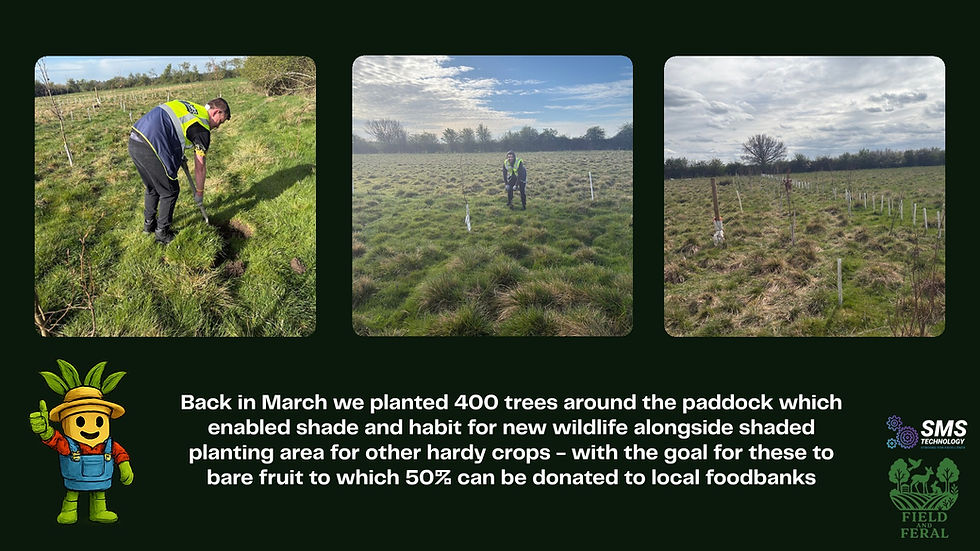
Earlier this year, SMS Technology continued its support for a regenerative agriculture farm in North Yorkshire, helping with the planting of 400 trees, including the development of a new fruit orchard.
The aim goes far beyond simply planting trees. The project is helping to create a productive landscape that can grow food, improve biodiversity, create new wildlife habitats and support the local community for years to come.
And we are already beginning to see the results.
From Tree Planting to a Productive Orchard
Planting hundreds of young trees is only the beginning.
For a new orchard to become successfully established, those trees need the right conditions during their first years of growth. This has been particularly important following a notably dry summer.
Supporting the orchard behind the scenes is the site's off-grid pump station, which has been providing irrigation to the young trees and helping give them the best possible opportunity to establish.
Now, some of the young orchard trees are already producing their first fruit.
It is a small milestone when compared with what the orchard could eventually produce, but an important indication of what can be achieved through long-term investment in regenerative agriculture and sustainable food production.
Creating New Habitats and Supporting Biodiversity
The benefits of the project are not limited to food production.
Planting trees and developing a diverse, productive landscape can create valuable new habitats for insects, birds and other wildlife.
As the site develops, wildlife is already beginning to return to the area.
This is an important part of the regenerative approach. Rather than viewing agricultural land purely in terms of how much food it can produce, regenerative farming considers soil health, biodiversity, habitat creation and long-term resilience alongside agricultural productivity.
The ambition is to create a landscape that becomes more productive and ecologically valuable as it matures.



Growing Food for Local Food Banks
One aspect of the North Yorkshire project that is particularly important to SMS Technology is its direct contribution to the local community.
50% of all food grown on the site is donated to local food banks.
That means the orchard is not simply creating an environmental benefit. As the trees mature and yields increase, it has the potential to provide increasing quantities of fresh, locally grown produce to people who need it.
A productive apple tree can produce thousands of apples over its lifetime.
Multiply that across an orchard containing numerous productive trees and the potential long-term contribution becomes significant.
What starts today as a collection of young trees could continue producing food for many years.
Measuring Performance Differently
In manufacturing and technology, performance is normally measured using clearly defined metrics.
Productivity. Quality. Efficiency. Output. Downtime. Improvement.
Those measurements remain fundamental to the work we do at SMS Technology, but supporting this project has provided a very different perspective on what measurable improvement can look like.
Here, the indicators of success are different:
Healthier and more resilient soil
New habitats and increasing biodiversity
Fruit trees becoming established and productive
Wildlife returning to the land
Sustainable local food production
Fresh produce being donated to local food banks
A landscape capable of delivering increasing value over time
There may not be a conventional dashboard displaying those results, but they can certainly be measured.
Technology Supporting Sustainable Agriculture
There is also an important connection between technology and the long-term success of projects like this.
The site's off-grid irrigation pump station is a good example.
While the trees and wildlife provide the visible signs of progress, infrastructure working quietly behind the scenes is helping make that progress possible.
During prolonged periods of dry weather, reliable irrigation can be critical for newly planted trees. Combining appropriate technology and infrastructure with regenerative farming practices can therefore help create more resilient and productive agricultural environments.
It demonstrates that sustainability and technology do not have to exist separately.
Used appropriately, technology can support sustainable agriculture, food production and environmental improvement.
Investing in Long-Term Social and Environmental Value
Businesses increasingly talk about sustainability, environmental responsibility and social value.
Projects like this demonstrate what those principles can look like when translated into practical action.
The trees planted today have the potential to provide benefits for decades.
They can produce food, provide habitats, support biodiversity, contribute to healthier ecosystems and help supply fresh produce to local food banks.
The impact should also increase as the orchard matures.
At SMS Technology, we spend much of our working lives looking at how organisations can achieve better performance and measurable improvement.
Supporting this regenerative farming project reminds us that improvement does not always happen immediately.
Some returns are measured in months. Others grow season after season.
And sometimes, one of the best long-term investments you can make is simply giving something the opportunity to grow.